gpty v0.5.4
v0.5.4 is the release where concepts became visible: a GraphEdit canvas that authors the same
concepts.json the engine already ran, conditions that narrow a match instead of widening it, and an
ordering rule - the canvas order is the precedence order. Under that sits the platform half: a
Windows runtime smoke that exercises the real pipeline, a security pass over the control socket and
the persistence stores, and the backpressure that stops a flooding pane growing the process or
freezing the window. The license changed as well: GPL-3.0-or-later, with section 7 exceptions that
keep plugins and data files free.
The canvas is the rule list
Settings → Concepts → “Open Visual Editor” opens a full-window GraphEdit overlay. A rule is a chain - trigger → condition* → action, where the action is either capture-and-route or notify-only - and each port holds one wire, so a rule cannot fork or merge. That is not arbitrary: a compiled entry’s identity is the trigger’s name, so one trigger is one rule, and a shared condition or action would compile two entries under one name.
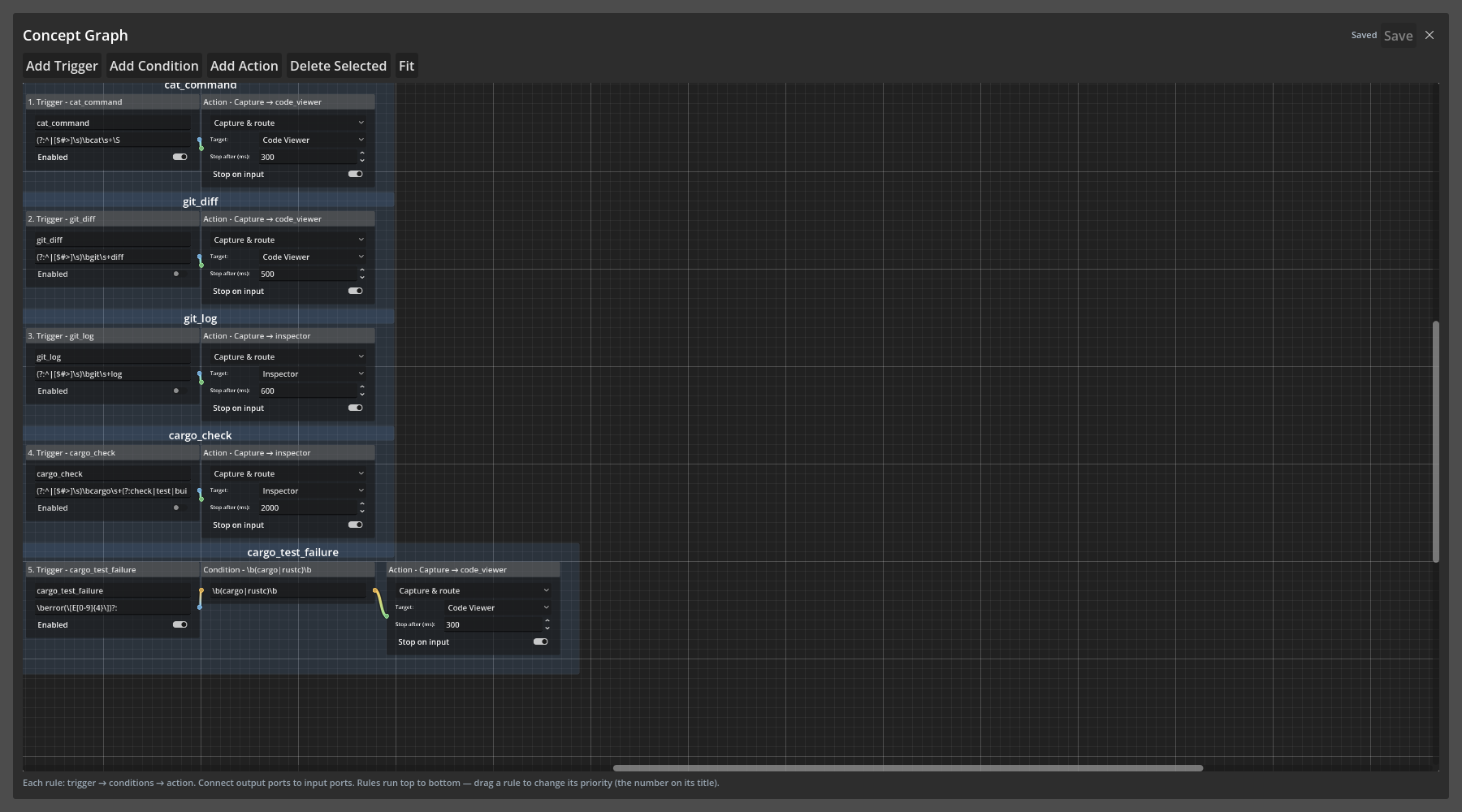
The canvas is not a second content store. concepts stays the single store; the new graph sibling
key in user://concepts.json holds only the canvas’s own state - node positions, drafts (so
unfinished work survives a close), and the rule order described below. ConceptGraphModel is pure
logic with 23 unit tests: it builds the canvas from the merged concepts, validates and compiles it
back, writes a rule equal to its shipped
default as no user entry (so defaults keep tracking updates), tombstones a deleted shipped rule
exactly like the manual dialog, and keeps a content-invalid rule as a draft rather than compiling it.
entry_for_path compiles a closed key set, so a node cannot smuggle a legacy cmd back into the file.
The order you see is the order that runs. Precedence used to be “shipped defaults first, then user
entries in file order”, so dragging a rule reordered nothing - the canvas only looked like a priority
list. The graph block now carries order (rule names, top-to-bottom), derived from the rules’ trigger
positions - top-to-bottom, then left-to-right, then by name - and ConceptManager._merge_concepts
puts the named rules first, with everything the canvas does not name behind them. A newly shipped
default can never quietly outrank an arrangement the user made, and a store with no order key keeps
exactly the shipped merge order. Each trigger’s title carries its rank, and “Fit” re-rows through the
new tidy_positions instead of Godot’s arrange_nodes(), which lays nodes out by connection shape
and would have silently reshuffled precedence. The live smoke against a real GUI and GDExtension
caught two defects first: rebuilding the canvas removed GraphEdit’s internal children, and auto-layout
spacing let an action node overlap a condition.
Conditions narrow the match, never widen it
A concept may now carry conditions: [regex, …]: extra predicates over the same line the trigger
matched, all of which must match before the concept fires. They can only narrow - a concept whose
conditions fail falls through to the next concept, and precedence is unchanged. Parsing rejects the
whole concept when a condition is not a string, is empty or oversized, does not compile, or the
list exceeds 8, because dropping a single condition would widen matching, the dangerous direction.
GDScript’s RegEx is PCRE2 and accepts look-around the Rust regex crate rejects - and
concepts_from_json silently drops such a concept - so GptyTerminal.validate_regex() exposes the
engine’s own dialect to the editor.
And the matcher stopped paying per concept. Matching cost is lines × concepts × regex, and the
per-concept loop paid each regex’s own prologue on every line - about 20 ns per concept, so a
128-concept library spent 2.7 µs on a line that matched nothing. A flooded pane lost most of its
throughput to it: 5.8 MB/s against 79.9 with no concepts at the parser’s ceiling (128 concepts, each a
1024-byte trigger plus eight 1024-byte conditions), and 8.6 against 47.3 for 128 typical triggers on
30-byte lines. ConceptMatcher now puts one combined RegexSet pass in front of the loop: the common
case - nothing matches - is answered by a single scan, and only a gate hit pays for the ordered loop
that decides capture-versus-notify. The gate cannot change a verdict - it is built from the same
triggers, conditions are still evaluated by the loop, and a test pins the equivalence - and the pane
flood went to 73.3 MB/s at the ceiling (12.6×), 44.9 on 30-byte lines (5.2×), 81.1 with the shipped
set. The probe that measured it is kept (cargo run --release -p gpty-core --example concept_probe),
with its results in the file’s header.
Windows runs the whole product now
The windows-smoke job (windows-latest) boots the GUI headless and drives the CLI against it: the
CLI and GDExtension are built for Windows, Godot 4.7.2’s editor is downloaded with its SHA512 pinned
from the release’s SHA512-SUMS.txt, and scripts/smoke_pane_api.py - one harness for every
platform, since only the transport differs (Unix socket versus named pipe, open() on both) - runs
the full flow: control round trip, the named-pipe event listener (subscribe/eventsPoll), pane
lifecycle, inject → pane-wait → pane-read, scrollback, broadcast, pane-run’s exit code, and
kill-pane. The GDScript suite runs on Windows too. Getting there was not cosmetic: 14 test files
pinned /bin/sh, which validate_executable refuses on Windows (a leading / is not absolute
there), the failed spawn logs an engine error, and GUT counts engine errors as failures.
Writing the job found real bugs. The first-run shell default was /bin/bash on every platform, so
every pane of a fresh Windows install came up with no terminal; it now answers %COMSPEC% (falling
back to cmd.exe), and pane-run now sends /c to the cmd family instead of -c. “Reset tab to
defaults” hard-coded /bin/bash in four places, and because SettingsManager is an autoload that
reset leaked into later test files. And a pane’s exit was never reported when the pty stayed open -
the task only learned of an exit from the read side closing, which ConPTY keeps open after the child
exits. It now polls the child every 200 ms and drains until the pty has been silent for 500 ms, a fix
testable on Linux with a SIGHUP-immune descendant holding the pty.
The extension is pinned, and the shutdown that needed it works. Godot unloads a GDExtension at
exit, and this one owns threads that live inside it - tokio workers, one PTY reader and one history
writer per pane. Under gdb the crash was a tokio-rt-worker faulting on a freed code page after
Godot’s own exit messages. pin_library() now holds the mapping (RTLD_NODELETE on Unix,
GetModuleHandleExW with PIN | FROM_ADDRESS on Windows) at InitStage::Core, before anything can
spawn a thread; daemon stop answers the client, raises a flag GDScript polls, and exits from a
scheduled task so the quit runs through the scene tree. Verified live 3/3 where the previous code
segfaulted.
Tier 2 agent state on Windows. ConPTY re-renders its own model rather than relaying the child’s VT
stream, so a sequence its engine does not implement never reaches the pane - measured: a DECSET 2004
from the same PowerShell fixture arrives while every gpty_state OSC declaration fails. gpty state <value> is the declaration path on every platform: it reads the credentials a pane injects and
submits gpty.state.declared on the event socket, capability-gated rather than spoofable and
display-only like the OSC. Recovering the OSC means owning CreatePseudoConsole with passthrough
mode; that is queued on the roadmap, not smuggled into this release.
The control surface and the stores got a security pass
Peer credentials fail closed everywhere an API exists. Linux and macOS already checked the peer’s
user; Windows had no check at all. The accept loop now identifies a pipe client with
GetNamedPipeClientProcessId, opens that process, reads its token’s user SID (TOKEN_USER through
GetTokenInformation) and compares it with gpty’s own via EqualSid, rejecting before the handler is
spawned. The BSDs share macOS’s getpeereid, and illumos/Solaris answer through getpeerucred; AIX,
Haiku and QNX keep the documented fail-open, which SECURITY.md states. Each new arm is verified
where it can run - FreeBSD compiles in CI, Windows through the xwin/clang-cl check, and illumos and
NetBSD were compile-probed against real libc targets.
The socket no longer falls back to a shared directory first. The chain used to end at
/tmp/gpty-<uid>.sock - ownership and mode are validated, so nobody can read or spoof traffic, but
another user can hold the name and deny the control surface. It now tries the per-user runtime
directories and then a private directory of our own ($XDG_STATE_HOME/gpty or
$HOME/.local/state/gpty), created 0700 or tightened from a lax umask, before the shared temp path.
The event socket derives from the same path, so it moves too, and a squatted path is a denial of
service rather than a way in. The pre-creation TOCTOU in the /tmp fallback is closed: only a stale
socket owned by this user is removed.
The stores are owner-only, and their writes are unguessable. SQLite created the history database -
and the -wal/-shm siblings - with the process umask, measured at 0644 here, so every line any
pane ever printed was readable by any account that could open user://. SQLite has no mode setting,
so history::restrict_to_owner chmods all three at open, unconditionally, which also tightens a
store written before this change the next time it is opened. Every user:// store goes through
BasePersistenceManager._write_file, whose temp file was the predictable <store>.tmp - and
FileAccess.open(..., WRITE) follows a symlink, measured: with a link planted at that name, the next
save wrote the store’s JSON into the victim file. GDScript has no O_EXCL, so the name is the
protection: the suffix is now 64 random bits, the file is created 0600 before the rename, and the
rename replaces the target itself rather than writing through a link at the store path.
The control surface answers, and refuses what it should. gpty mcp read stdin with lines(),
which buffers a request of any length; a line over 65536 bytes - the control socket’s own cap - is now
refused with -32600 "Request exceeds 65536 bytes" and discarded so the next request starts at a
message boundary. An idle event subscription is released after 120 s without an eventsPoll, so 64
abandoned clients cannot exhaust the slot cap permanently, and the extension’s translated events are
allowlisted to the fields AGENTS.md documents. A bare program name is judged by the file it resolves
to: validate_program resolves it through the PATH the child will actually inherit and holds the
first match to the existing rule - regular file, not group/other-writable, owner check, no writable
ancestor.
A flooding pane stops taking everything with it
Output has a queue, so the process has a bound. pty_rx was unbounded, so a pane whose output
outran the terminal task grew the process until it died: a yes pane added ~70 MiB/s to the GUI (194
→ 1248 MiB in 15 s) and 2.2 GiB in 20 s in a bare gpty-core harness. The reader thread now sends on
a queue bounded at 256 × 4 KiB = 1 MiB per pane and blocks while it is full, so the kernel’s PTY
buffer fills and the child’s write blocks in turn - the backpressure a terminal emulator has always
applied. Dropping chunks was never an option: these bytes carry ANSI state, not independent records.
Measured after: RSS flat at 216 MiB across 15 s of yes in the GUI, with the drain rate unchanged
(29.5k → 31.1k lines/s - the ceiling is the consumer, not the channel).
Input no longer blocks the drain loop. The task wrote user input and emulator replies straight to
the PTY master, so a child that stopped reading stdin filled the kernel’s ~4 KiB input buffer and the
task blocked inside write_all - which stopped it draining PTY output, so the pane froze, and an
abort could not land either because abort only takes effect at an await point. Input now goes to a
per-PTY writer thread through an unbounded FIFO, which coalesces whatever is queued before each write
and logs a write error instead of returning it. Verified live: 64 KiB injected into a pane flooding
yes returned in 7 ms with output flowing before and after.
Scrollback is committed off the terminal path. TermGrid::store_line called HistoryStore::append
per output line while holding the grid mutex - the lock the UI thread renders under - so a flooding
pane held the UI up for ~30 µs per line and was itself capped at 33k lines/s (a yes pane moved
~1 MB/s), and the store had no byte cap at all. A pane now owns a PaneHistory: push queues the
line with no lock and no SQLite on the terminal path, and a per-pane writer thread commits batches -
512 rows, or 200 ms of quiet - then trims the store, bounded by rows (history_lines) and by text
bytes (1 KiB per retained row, minimum 1 MiB). Measured: the pane’s ceiling went from ~1 MB/s to
31 MB/s of yes output with GUI RSS flat at 219 MiB. The cost is staleness - a search can miss the
last 200 ms - so the tail is flushed on a normal exit, and Settings → Terminal now carries a read-only
“On disk:” row sourced from SQLite’s own accounting: the database plus its -wal/-shm siblings,
measured live as 61 111 896 = 56 938 496 + 32 768 + 4 140 632 exactly.
Killing a pane kills its work. PtyHandle::drop killed only the shell, and a shell’s descendants
do not always follow it: the kernel’s SIGHUP on session-leader exit reaches the foreground group, so
a background job under job control - what an interactive pane produces - or a process that ignores
SIGHUP is orphaned. The drop path now SIGKILLs the child’s process group first (the child is a session
leader, so pgid == pid), then the child.
The smaller repairs
A divider drag is pixel-smooth. It used to move in whole grid units (~17 px on a 1000 px pane),
and every motion event mutated the tile model and emitted tiles_resized, so the grid relayouted and
every terminal reflowed on each 1–3 px mouse step. A drag now previews in pixels and commits in units:
each motion moves the wrappers by the raw delta, touching neither the tile model nor tiles_resized,
and the release rounds the previewed travel to whole units and relayouts exactly once, with MIN_TILE
enforced mid-drag in pixels so the preview can never show a position the commit refuses.
A paste is now bracketed, or guarded. A paste went to the PTY verbatim: every newline submitted a
line, and any control byte in the clipboard was injected raw - a pasted ESC[201~ closed the
application’s own paste bracket, a ^C interrupted. The grid now reports DECSET 2004, and
TerminalPane.build_paste_payload wraps the text in ESC[200~/ESC[201~ when the child asked for
it. When it did not ask, C0 controls and DEL are dropped - escape sequences above all, and a bare CR,
which the PTY turns into Enter - while newlines and tabs survive.
And the quieter fixes. The code viewer read any absolute path with get_as_text(), so a layout path
or a typo could be a multi-GB file slurped whole on the GUI thread; reads are capped at 1 MiB with a
truncation notice, and non-regular paths are refused before open. The file tree asks before
OS.shell_open, because a downloaded .desktop file is run by the mime handler rather than
displayed. log::warn! records that were invisible in the GUI reach Godot’s console through a bridge
at InitStage::Core; reasoning deltas render at most once per 75 ms per view; and every store loader
reads through typed accessors, so a wrongly typed value costs that value instead of raising mid-load
and letting the next save write the reduced state back over the file.
GPL-3.0-or-later, with the plugin door open
gpty is now licensed GPL-3.0-or-later. LICENSE is the verbatim GPLv3 text, and
LICENSE-EXCEPTIONS.md states the
section 7 additional permissions: plugins, pane types, extensions and adapters may be licensed under
any terms - Apache-2.0, MIT, proprietary - and configuration or data files carry no copyleft, so
user-authored files are the user’s own and the shipped godot/*.json defaults are Apache-2.0. Both
permissions carry the as-is, no-warranty, no-vetting terms. The core stays copyleft: modified gpty
source is still conveyed under the GPLv3. SPDX cannot express an exception, so
LICENSE-EXCEPTIONS.md is the canonical statement; the crates and the AUR PKGBUILD declare
GPL-3.0-or-later, and CONTRIBUTING gains the inbound=outbound statement the GPLv3 lacks. There is a
single copyright holder, so no third-party consent was required. The release archives now carry
LICENSE and LICENSE-EXCEPTIONS.md next to the binaries (GPLv3 sections 4 and 6), and the docs site
renders the license text and the exceptions.
The bundles changed too: each platform job now builds the CLI into the archive beside the GUI
export - renamed gpty-gui on Linux and Windows, while macOS keeps the preset-owned gPTY.app - so
gpty new-pane, pane-read and gpty mcp no longer need a Rust toolchain, and every bundle ships a
real application icon and a SHA256SUMS asset. CI and the release export are pinned to
Godot 4.7.2, and the build fails fast when the export templates do not match the editor.
Release
- Download the standalone binary from GitHub Releases.
- Full changelog: Changelog.
- Source: github.com/godot-pty/gpty.